
Amerex STRIKE Kitchen Fire Suppression and TR19 Duct Cleaning

Commercial kitchen fire safety depends on effective grease management, reliable fire suppression and a clear understanding of your responsibilities. For restaurants, hotels, caterers and food service operators, these measures need to work together.
Equipro designs, supplies and installs Amerex STRIKE kitchen fire suppression systems, provides TR19® Grease kitchen extraction cleaning and advises businesses on their fire safety legal obligations. As a trusted partner in the food service sector, we help operators coordinate fire protection and cleaning around the demands of a working kitchen.
Amerex STRIKE supports this approach through electronic detection and control technology that reduces the traditional mechanical components cleaning contractors need to work around.

Why TR19 duct cleaning matters
Cooking produces grease-laden vapour that enters the kitchen extraction system. Deposits can accumulate inside the canopy, plenum, ductwork and fan, creating a fire risk beyond the visible cooking area.
BESA’s TR19® Grease specification addresses fire risk management through the control of grease accumulation within kitchen extraction systems. Often referred to as TR19 duct cleaning or TR-19 cleaning, it provides an established framework for managing extraction cleanliness.
Read BESA’s TR19 guidance.
A clean-looking canopy does not establish that the connected ductwork and fan are clean. An effective cleaning programme needs to address the complete extraction system, identify access limitations and retain evidence of the work completed.
Equipro provides TR19 kitchen extraction cleaning to help food service businesses manage grease accumulation as part of their wider fire safety arrangements.
What is Amerex STRIKE?
Amerex STRIKE is an electronic control system designed for use with the Amerex KP wet chemical kitchen fire suppression system. It provides fire detection, actuation and system monitoring.
STRIKE uses electronic components in place of traditional mechanical equipment such as fusible links, stainless steel detection cable and corner pulleys. Amerex also identifies reduced grease build-up on components and downloadable fault and actuation reports among its features. Explore Amerex KP and STRIKE.
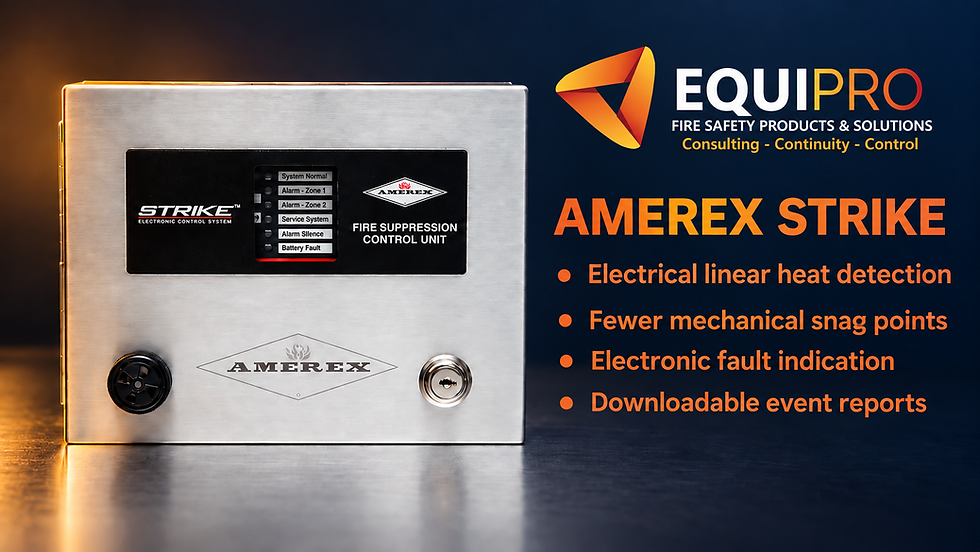
Equipro designs, supplies and installs Amerex KP systems with STRIKE controls around the cooking equipment, kitchen layout and applicable project requirements.
How Amerex STRIKE supports extraction cleaning
Fire suppression equipment occupies areas that cleaning contractors need to access. The arrangement of detectors, nozzles and associated components therefore matters when planning how cleaning will be carried out.
STRIKE’s electrical linear heat detection reduces the mechanical hardware associated with traditional fusible-link detection. In practical terms, fewer exposed mechanical components can mean fewer opportunities for cleaning equipment to snag on detection hardware.
This can help cleaning and fire protection work together more effectively. Suitable cleaning methods remain essential, and detectors, wiring and suppression nozzles still need to be protected against damage or disturbance.
TR19 cleaning and fire suppression perform complementary roles: cleaning controls grease accumulation, while suppression responds to a fire. Installing STRIKE does not replace extraction cleaning or ongoing system maintenance.

Plan cleaning and fire suppression maintenance together
A coordinated maintenance programme helps everyone understand who is responsible for protecting equipment, recording defects and confirming that the kitchen is ready to operate.
Before cleaning begins, the plan should establish:
The extraction components to be cleaned and any access restrictions.
The location of detection equipment, suppression nozzles and associated components.
Suitable methods for protecting equipment during cleaning.
Competent management of any necessary temporary system impairment.
Post-cleaning checks and servicing required by the manufacturer.
How defects, corrective actions and reinstatement will be recorded.
Before cooking resumes, affected fire protection must be properly reinstated and its operational status confirmed by competent personnel.
Equipro can coordinate extraction cleaning and suppression servicing within one maintenance programme, while preserving the appropriate intervals and requirements for each activity.

Understanding TR19, NFPA and EN requirements
Businesses operating across different locations may encounter TR19 specifications, NFPA standards and European EN standards. Each addresses particular aspects of fire safety, and its application depends on the premises and project requirements.
TR19® Grease: kitchen extraction cleanliness
TR19® Grease focuses on managing fire risk from grease accumulation within kitchen extraction systems. Its relevance may arise through project specifications, contracts, insurance conditions and the arrangements adopted to manage fire risk.

It is a technical specification rather than a universal law applying identically in every country. BESA’s TR19® Grease overview.
NFPA 96 and NFPA 17A: commercial cooking and suppression
For projects working to NFPA requirements, NFPA 96 addresses ventilation control and fire protection for commercial cooking operations, including inspection and maintenance. NFPA 17A addresses wet chemical extinguishing systems. NFPA 96 information, NFPA publications.
The applicable editions, local adoption and acceptance requirements should be established with the authority having jurisdiction. TR19 cleaning records can contribute to a maintenance file, but they do not independently demonstrate NFPA compliance.
EN 17446: commercial kitchen fire-extinguishing systems
EN 17446 addresses commercial kitchen fire-extinguishing systems, including system design, documentation and test requirements. Where it is specified, the proposed configuration and supporting certification must be checked against the project requirements. BSI’s EN 17446 details.
Approval under one testing or certification scheme should not be assumed to establish conformity with another.
Equipro helps operators understand the requirements relevant to their premises and proposed installation, bringing practical fire safety advice into the planning process.

Keep clear cleaning and fire protection records
A useful kitchen fire safety file connects the condition of the extraction system with the status of its fire protection.
Records should include:
Extraction-system drawings, cleaning schedules and agreed scopes.
Cleaning reports, photographs and details of inaccessible areas.
Suppression-system design, commissioning and service documents.
Identified defects, corrective actions and outstanding work.
Records of any system impairment and subsequent return to service.
Keeping this information together helps operators plan future maintenance and explain how fire risks are being managed to insurers, assessors and other relevant parties.
Frequently asked questions

Is a kitchen fire suppression system a legal requirement in the UK?
There is no blanket rule requiring automatic fire suppression in every UK commercial kitchen.
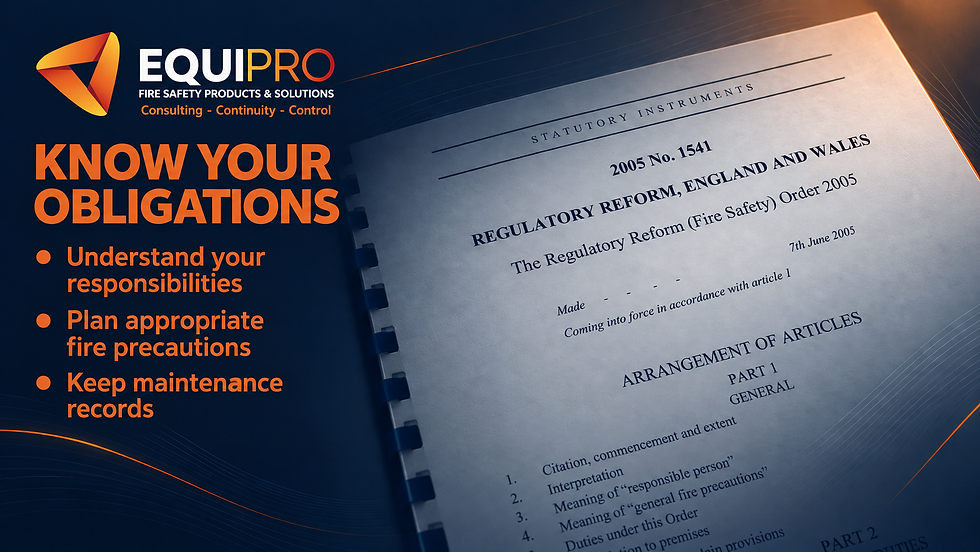
In England and Wales, the Regulatory Reform (Fire Safety) Order 2005 requires the responsible person to assess fire risks and put in place and maintain appropriate fire safety measures. Scotland and Northern Ireland have separate fire safety legislation. Government fire safety guidance.
A kitchen’s fire risk assessment may identify automatic suppression as a necessary measure, particularly where cooking equipment presents significant risks. Insurers and landlords may also make it a condition of cover or occupation.
Equipro can help you understand the requirements affecting your premises and specify a suitable kitchen fire suppression system.
How often does kitchen extraction ductwork need cleaning?
Cleaning frequency depends on kitchen usage and how quickly grease accumulates. BESA’s published TR19® Grease guidance gives these baseline intervals:
Heavy use, 12–16 hours daily: every three months.
Moderate use, 6–12 hours daily: every six months.
Light use, 2–6 hours daily: every 12 months.
A competent person should determine the actual frequency using cooking methods, grease accumulation and deposit-testing results. The schedule should be reviewed regularly, and more frequent cleaning may be necessary. BESA’s kitchen extraction cleaning guidance.
Insurance conditions may also specify cleaning requirements. Equipro provides TR19 extraction cleaning and can coordinate it with suppression servicing within one maintenance plan.
How does a kitchen fire suppression system work?
In an Amerex KP system with STRIKE controls, heat detection triggers the release of wet chemical agent through nozzles positioned to protect the specified cooking appliances, canopy and extraction areas. The installation also incorporates the required cooking-energy shutdown arrangements.
The agent cools hot surfaces and reacts with cooking oils and fats to form a protective, soap-like layer that helps prevent re-ignition. STRIKE provides electronic detection and control in place of traditional mechanical detection components. Amerex KP technical specification.
Equipro designs each installation around your appliances, extraction layout and the system’s approved coverage.

What is the difference between wet chemical and other kitchen suppression systems?
Wet chemical systems are designed to tackle cooking-oil and fat fires. They combine cooling with a chemical reaction called saponification, which forms a protective layer over the burning cooking media.
Other suppression technologies use different extinguishing methods and have different approved applications. The appropriate choice depends on the cooking hazards, tested system coverage and applicable requirements.
Amerex KP uses wet chemical agent, while STRIKE provides its electronic detection and control. Equipro can assess your kitchen and explain the appropriate protection.
How much does a commercial kitchen fire suppression system cost?
Cost depends on the number and type of cooking appliances, the canopy and extraction arrangement, the standard specified and the complexity of installation. Ongoing servicing and the scope of any maintenance contract also affect the overall cost.
Equipro can assess your kitchen and provide a survey-based quotation for an Amerex STRIKE installation, with a clear scope of work.
How often should a kitchen fire suppression system be serviced?
Servicing must follow the manufacturer’s instructions and the applicable fire protection standard, together with local requirements. The correct schedule should be established for your particular system, including any additional checks needed after extraction cleaning, alterations or a discharge.
Equipro can coordinate suppression servicing and TR19 duct cleaning within one planned maintenance schedule, while maintaining the intervals required for each.
How long does installation take, and will my kitchen have to close?
Installation time depends on the number and type of appliances, the canopy and extraction layout, access, and whether the project is a new installation or a retrofit. Connections to fuel shut-offs, electrical supplies and other building systems also affect the programme.
Work may be planned around service hours where practical. The affected cooking area will need to be out of use during work that prevents safe operation, including relevant installation and commissioning activities.
Equipro surveys the kitchen and agrees a programme with you, including anticipated downtime, before work begins.
Does Amerex STRIKE replace TR19 duct cleaning?
No. STRIKE provides detection and control for the Amerex KP fire suppression system. Extraction cleaning remains necessary to manage grease accumulation throughout the kitchen extract system.
Does installing Amerex STRIKE automatically establish NFPA or EN compliance?
No. Compliance depends on the exact system configuration, applicable approvals, correct installation, maintenance and local requirements. These must be checked for each project alongside the wider fire safety arrangements.
Can Equipro provide both fire suppression and extraction cleaning?
Yes. Equipro designs, supplies and installs Amerex STRIKE systems, provides TR19 kitchen extraction cleaning and advises food service businesses on their fire safety obligations.
Equipro: your trusted fire safety partner in the food service sector
Commercial kitchens need fire safety support that connects equipment, cleaning and operational responsibilities.
Equipro brings together Amerex STRIKE system design, supply and installation, TR19 kitchen extraction cleaning, and advice on fire safety legal obligations. We help food service operators understand the requirements affecting their premises and plan the work needed to address them.
Whether you are opening a new kitchen, upgrading existing suppression equipment or reviewing your extraction cleaning programme, Equipro can help you develop a coordinated approach.
Equipro can also act as your outsourced fire safety manager, taking care of the fire compliance requirements, fire protection systems and maintenance covered by your agreement. Our managed service is typically provided through a three- or five-year agreement for a fixed monthly fee.
Within that agreed scope, the monthly fee covers the work needed to meet applicable fire safety regulations, together with the necessary systems and maintenance. This gives you one point of contact, planned support and predictable costs for managing your premises’ fire safety.
Contact Equipro to discuss Amerex STRIKE, TR19 duct cleaning or a fixed monthly fire safety management agreement for your business.


Comments