

You Don't Need to Open the Box
Why Direct Cell Access Is Not a Prerequisite for Stopping Thermal Runaway — What Our 120 kWh Live Fire Test Proves
===================================================================================================================
There is a persistent belief in the EV fire protection sector that an effective suppression agent must have direct physical access to exposed battery cells to interrupt cell-to-cell thermal runaway propagation. It sounds logical on paper. However, it is demonstrably wrong — and we have the test footage to prove it.
The Test
The video above shows an EQUINOX-HP mist system deployed on a fully sealed 120 kWh EV battery pack that has been deliberately induced into thermal runaway under controlled, third-party witnessed conditions. At no point during the test are the cells exposed. The pack remains sealed throughout.
The result? Thermal runaway is halted. Cell-to-cell propagation is stopped. The system performs.
Why It Works — The Physics
The mechanism is rooted in thermodynamics, not chemistry. When deionised water is dosed with a certified NFPA 18A water additive such as Cold Fire, it undergoes a dramatic shift in its heat-absorbing capacity. The resulting solution becomes a voracious heat absorber.
Contact with the external surface of a sealed battery pack — even through casing, through enclosure walls, or through whatever structural barrier lies between the system and the cells — is sufficient to extract heat at a rate that the pack cannot sustain its own runaway cascade. The thermal energy required to push an adjacent cell over its critical threshold is simply not there anymore. No breach. No injection. No direct cell contact. Just rapid, sustained heat extraction applied at the boundary of the pack.
What This Challenges
The "direct access" school of thought has driven a generation of EV fire suppression designs towards invasive solutions. These include internal nozzle arrays, pack-penetrating systems, and complex detection schemes designed to breach the enclosure at the point of event.
These approaches have merit in some contexts, but they also introduce:
Significant installation complexity and cost
Pack-specific engineering for every application
Vulnerability to single-point failures within the enclosure
Questions around IP integrity and warranty implications for OEMs
Our approach is different. EQUINOX systems work around the pack, not inside it. That distinction matters enormously when you are protecting assets across a range of form factors — from small device battery banks to 800 kg vehicle packs, from e-bike charging stations to BESS installations.
The Wider Evidence Base
This test is not a one-off. Across Equipro's third-party testing and witnessed fieldwork, we have seen the same principle validated repeatedly using Cold Fire water additive deployed across a range of delivery systems. These include portable and wheeled extinguishers, adapted hose reel systems, EQUINOX-HP high-pressure Cold Fire mist, and EQUINOX sprinkler configurations.
The evidence is consistent: effective heat extraction through external contact is sufficient to arrest propagation inside sealed lithium-ion packs. Direct cell access is a design choice, not a technical necessity.
Certification and Independence
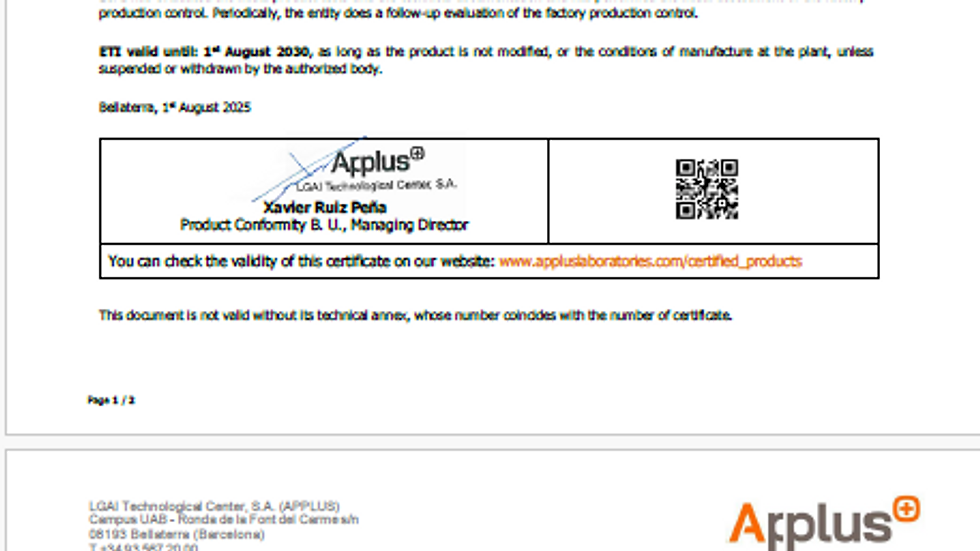
All EQUINOX systems are third-party tested and certified by Applus+ Laboratories — an internationally recognised, independent test authority. Our certifications cover e-bike and micro-mobility applications as well as conventional water mist performance. We continue to expand our test programme as the regulatory landscape for EV and BESS suppression develops — including active involvement in the development of the forthcoming European BESS fire suppression test standard at CEN/TC 191 level.
Applications
The combination of sealed-pack effectiveness and the Cold Fire mechanism means EQUINOX systems are well suited to:
EV car parks and charging stations
E-bike, e-scooter, and e-mobility charging facilities
Industrial e-forklift charging areas
BESS (Battery Energy Storage Systems)
Warehousing and logistics facilities storing lithium-ion products
Waste and recycling operations
Because Cold Fire is UL-listed as a wetting agent effective on Class A and Class B (polar and non-polar) fires, these systems also provide genuine utility beyond lithium-ion. This makes them an attractive PFAS-free alternative to foam-based systems for fire and rescue services and industrial operators alike.
The Bottom Line
If you are specifying or procuring fire suppression for lithium-ion battery applications — and you have been told that any effective system must breach the pack or access exposed cells — I invite you to watch the video above and reconsider that assumption.
EQUINOX systems do not require direct access to exposed cells to halt internal cell-to-cell propagation. The physics work without it. The tests prove it. The certifications back it up.
If thermal runaway protection is on your agenda, I would welcome the conversation.
Conclusion: Rethinking Fire Suppression Strategies
The traditional belief that direct access is necessary for effective fire suppression in lithium-ion batteries is outdated. My experience and the evidence from our tests show that effective heat extraction can occur without breaching the battery pack. This insight can reshape how we approach fire safety in high-risk environments.
As we continue to innovate and refine our systems, I encourage you to explore the potential of EQUINOX solutions. They offer a robust, effective alternative to conventional methods, ensuring safety and compliance in complex applications.
By embracing these advancements, we can enhance fire protection strategies across various sectors. The future of fire suppression in lithium-ion applications is here — and it does not require direct cell access to be effective.


Comments